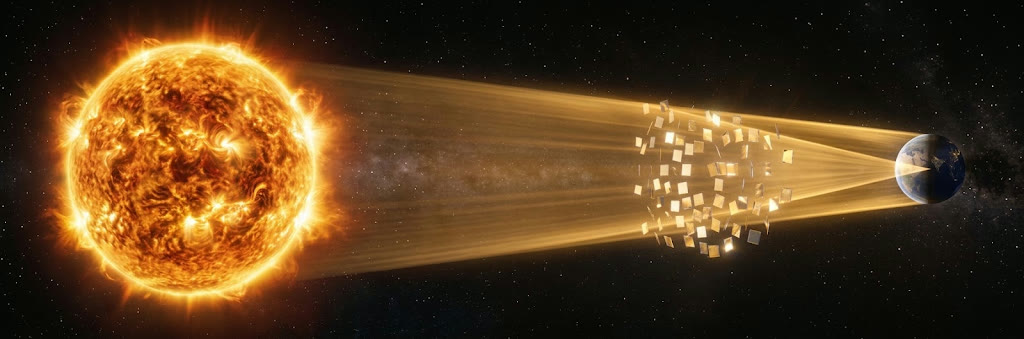
Research Concept
SPECULORUM
The Astral Cone of Luca — A Swarm of Diverging Lenses for Modular Management of Earth's Insolation
Astral cone · Sidereal cone · Stellar cone
From geometric concept to lunar industrial implementation. A preliminary, modular, incremental feasibility study.
Section 1
The Vision and the Definitions
Luca's Cone (the "Cone of Luca")
The space enclosed between the circumference of the Sun and the circumference of the Earth.
- Etymology: "Luca" derives from Latin lux, lucis (light) — literally the "cone of light".
- Definition points: NS / MS / SS — North / Middle / South of the Sun; NT / MT / ST — North / Middle / South of the Earth. These points change continuously with respect to the cone.
- Key relations: MS–MT = shortest distance between the two semicircles; NS–SS and NT–ST = the diameters of the Sun and the Earth with respect to the cone.
- Three baptismal names: Luca's Astral Cone, Luca's Sidereal Cone, Luca's Stellar Cone.
The cone is the channel of solar energy: fundamental for our planet.
Section 2
The Problem and the Climate Target
The energy challenge
- Current anthropogenic (greenhouse-gas) forcing: ≈ +2.7–3.0 W/m².
- Full compensation via solar reduction would require ≈ 1.2–1.5 % of the solar constant (1361 W/m²).
Modular strategy
- Module 1 (0.5 %): ΔS ≈ 6.8 W/m² → forcing ≈ −1.2 W/m² (≈ 40–45 % of current forcing; avoids ~0.6–1.0 °C at equilibrium).
- The swarm can grow in +0.5 % modules or shrink: the climate "knob" is adjustable and reversible.
- It does not replace decarbonization (it does not cure ocean acidification).
Section 3
Where: Inside the Cone, Close to Earth
The geometry of Luca's Cone
The Sun is not a point source: the Earth-bound light beam converges; the closer the shade is to Earth, the smaller it can be.
- Beam radius at fraction f of the distance: R(f) = R<sub>Sun</sub>·(1−f) + R<sub>Earth</sub>·f.
- At 1/3 of the distance: ≈ 3.4×10⁹ km² would be needed (0.5 %) — impractical.
- Near L1: only ≈ 3.0×10⁶ km² — ~1,100 times less.
- Nominal position: ~1.6 million km from Earth (classical L1 + ~100,000 km sunward due to residual light pressure β).
Section 4
The Element (Block 1)
Symmetric diverging Fresnel lens, ~1°
- Function: spreads the light over ~28,000 km after 1.5 million km → nearly all of it misses the Earth.
- Why not mirrors or disks: light pressure (β up to 0.3) would push them millions of km out of position.
Gen-1 specifications
| Size | 1 km × 1 km |
| Areal density | σ ≈ 5 g/m² |
| Mass per element | ≈ 5 t |
| Safety 'off' state | Rotating the lens edge-on makes the intercepted area ≈ 0; continuous modulation ∝ cos θ |
| Transparency | > 95 % to minimize residual thrust |
Section 5
Orbit and Natural Dynamics (Block 2)
Stability and control
- Transverse: Earth's tidal gravity acts as a weak "spring" → natural oscillations with a period of ~6–7 months → self-confinement within the beam disk (radius ≈ 13,800 km).
- Axial: saddle point with e-folding time ~3 weeks → continuous trim required.
- Photonic rudders (reflective trim tabs, ~1 % of the area): authority ≈ 9×10⁻⁶ m/s² ≈ 280 m/s per year, propellant-free; real budget only a few m/s per year (margin ~25×).
- The swarm is always on the sunward side: never in Earth's shadow.
Section 6
Swarm Management, Safety, Collisions
An ordered system, not a chaotic "gas"
- Ordered lattice (correlated oscillation phases): relative velocity ≈ mm/s.
- Mean spacing: ≈ 14 km between elements.
- Collisions: autonomous avoidance via photonic rudders; residual impacts only a few per year, tolerated by the thin film.
- Emergency response: shading 0.5 % → 0 in a few days (edge-on rotation) — the safety valve, e.g. after a major volcanic eruption.
- Onboard autonomy (sun sensor + simple logic); radio delay from Earth ≈ 5 s.
Section 7
Manufacturing: The Moon as Factory (Block 3)
Mass and production
- Total mass (first 0.5 % module): 15 million tonnes (3 million elements × 5 t).
- Per-element breakdown: 2–3 µm glass lens ≈ 4 t · booms/tethers ≈ 0.7 t · control package ≈ 0.3 t.
- 94 % of the mass from the Moon: glass from regolith (abundant Si, O). 6 % high-tech from Earth (~0.9 M t ≈ 6–9 thousand heavy launches over 10 years).
- Logistics: lunar mass driver (2.4 km/s, ~3 MJ/kg) + reusable electric tugs; average power ≈ 140 MW — negligible.
- Steady-state rate: 300–450 thousand elements per year, including ~300 thousand scheduled replacements (10-year lifetime).
Section 8
Key Project Numbers
| Item | Value |
|---|---|
| Position | ~1.6 M km from Earth (L1 + β shift) |
| First module | 0.5 % = 3.0×10⁶ km² = 3 M elements of 1 km² |
| Total mass | ~15 M t (94 % Moon / 6 % Earth) |
| Transverse stability | Natural, ~6–7 months |
| Axial control | Photonic rudders, few m/s per year |
| Spacing / collisions | 14 km / few tolerable impacts per year |
| Response time | Off in a few days |
| Lifetime / replacements | 10 years / ~300 k per year |
Section 9
Phased Roadmap
| Phase | Years | Content | Shading |
|---|---|---|---|
| 0 | 0–3 | Earth-launched prototypes (1–10 k elements) | ≤ 0.002 % |
| 1 | 3–8 | Terrestrial line + lunar pilot plant | 0.1 % |
| 2 | 8–18 | Full-scale lunar industry | 0.5 % |
| 3+ | 18– | Additional +0.5 % modules with Gen-2/3 | up to 1.5 % |
Section 10
Costs and Global Context
- Economic estimate: R&D + Phase 0: $50–100 B · Lunar infrastructure: $300–800 B · Production/deployment: $1,000–3,000 B · O&M: $100–300 B/year.
- Total first 0.5 %: ≈ $1.5–4 T over 15–20 years ≈ 0.1–0.3 % of world GDP per year.
- Comparisons: global military spending ≈ $2.4 T/year; current climate damages ≈ $0.5–1 T/year and rising.
- Cost/benefit potentially favorable, if combined with (not substituted for) decarbonization.
Section 11
Evolution: Gen-2 and Gen-3
Continuous improvement
- Gen-2: areal density reduced to 1–2 g/m² (sub-micron films, 2D materials) → mass and costs ÷3–5.
- Materials: polymers from carbonaceous asteroids (C, H) for advanced optics.
- Scalability: each +0.5 % = ~3 M additional elements in the same lattice, with no orbit redesign.
- Design and manufacturing improve module after module, by project philosophy.
Section 12
Safety and Governance
- Fast reversibility (off in days) → management of natural shocks (volcanoes); gradual ramp-down avoids "termination shock".
- Acts mainly on the tropics — complementary to the polar pattern of CO₂ forcing.
- Global governance of the climate "knob" is required: decision rules, monitoring, protocols.
- The swarm is repairable and replaceable piece by piece: no single point of failure.
Section 13
Conclusions and Next Steps
From Luca's Cone to planetary infrastructure
- A consistent preliminary feasibility study across geometry, orbit, masses, energy and costs.
- Required deep-dive studies:
- Qualification of 2 µm glass film + Fresnel prisms at 1 AU.
- Simulation of the lattice and autonomous control of 3 million bodies.
- Definition of the international governance framework.
- Luca's Cone evolves from a geometric definition into a modular planetary infrastructure.
Appendix: Formulas and Constants
- Solar constant (S₀): 1361 W/m²; albedo 0.3; ΔS = 4F/(1−α)
- Beam radius: R(f) = RSun·(1−f) + REarth·f
- Module area: A = x·πR² (x = shading fraction)
- Light-pressure factor (β): lenses ≈ 0.001–0.008; mirrors ≈ 0.3
- Lens divergence: ~1° → spot ~28,000 km at 1.5 M km > REarth
- σ budget: 5 g/m² (Gen-1); 1–2 g/m² (Gen-2)
- Constants: RSun 696,340 km; REarth 6,371 km; d 149.6 M km; L1 ≈ 1.5 M km